
Ask any sports club coach or administrator what keeps them up at night, and equipment management will almost certainly appear on the list. From missing training bibs to broken goal nets, from lost cones to expensive kit that somehow vanishes between seasons, the challenge of managing a club’s physical assets is one of the most underestimated administrative burdens in youth sports. Yet it is also one of the most solvable — with the right systems in place.
In this comprehensive guide, we will explore why sports club equipment management matters far more than most clubs realise, the real costs of poor inventory control, and how to build a practical system that keeps your equipment organised, maintained, and ready to use. Whether you run a small community football club or a multi-sport academy with hundreds of young athletes, the principles in this guide will help you save money, reduce stress, and present a more professional image to your members and their families.
We understand that coaches and club owners are already stretched thin. Between planning training sessions, communicating with parents, managing membership fees, and trying to keep young athletes motivated, the last thing you need is to spend twenty minutes before practice searching for the training bibs that were definitely in the storage room last week. That is the problem this guide is designed to solve. If you are also looking to streamline other areas of club administration, our guide on sports club season planning is an excellent companion read.
Why Sports Club Equipment Management Is a Serious Business
It is tempting to dismiss equipment management as a minor administrative concern — something that takes care of itself as long as coaches remember to pack up after training. But the financial reality of poor equipment management tells a very different story.
Consider a typical youth football club with four age-group teams. Each team requires training bibs, cones, agility poles, balls, and a set of portable goals. When you add up the replacement cost of equipment that is lost, damaged, or simply not tracked properly, the annual bill can easily run into hundreds or even thousands of pounds, dollars, or euros. For a club that relies on membership fees and fundraising to survive, this is money that could have been spent on coaching courses, facility upgrades, or reduced fees for families who are struggling financially.
Beyond the direct financial cost, poor equipment management has a significant impact on training quality. A coach who arrives at the pitch to find that half the training cones are missing and the ball pump cannot be located will inevitably deliver a less effective session. Young athletes notice when a club is disorganised, and so do their parents. In an era where families have more choices than ever about how their children spend their time, the professionalism of a club’s operations can be a deciding factor in whether a family stays or moves on.
There is also a safety dimension to equipment management that is often overlooked. Damaged or poorly maintained equipment poses a genuine risk of injury. A goal net with a broken anchor, a gymnastics mat with a torn surface, or a basketball hoop with a loose backboard are not just inconveniences — they are potential liability issues. A robust equipment management system ensures that safety checks are conducted regularly and that damaged items are repaired or replaced before they cause harm.
The Hidden Costs of Informal Equipment Tracking
Most sports clubs manage their equipment informally — relying on the memory of a dedicated volunteer, a rough list scrawled on a whiteboard in the storage room, or simply the assumption that experienced coaches know where everything is. While this approach works well enough when a club is very small, it breaks down rapidly as the club grows and more people need access to shared equipment.
The most common hidden cost is the “it was here last week” problem. When equipment is not formally tracked, items gradually migrate to the wrong storage locations, get left at away venues, or end up in the boots of coaches’ cars. Recovering these items requires time and communication — two resources that are always in short supply at a busy sports club.
Another significant hidden cost is over-purchasing. Without a clear inventory, clubs frequently buy replacement items for equipment that is not actually missing — it is simply stored in the wrong place. A club might purchase a new set of training bibs in September, only to discover the original set in a different storage bag in October. Multiply this across multiple equipment categories and multiple seasons, and the waste becomes substantial.
Finally, informal tracking makes it impossible to plan equipment budgets accurately. If you do not know what you have, what condition it is in, and when it is likely to need replacing, you cannot budget for it effectively. This leads to the all-too-common scenario of a club being caught off-guard by a large equipment expense at the worst possible time — often at the start of a new season when cash flow is already tight.
Building Your Equipment Inventory: A Step-by-Step Approach
The foundation of any effective sports club equipment management system is a comprehensive, up-to-date inventory. Building this inventory for the first time requires an investment of time, but it pays dividends immediately and for every season that follows.
Begin with a complete physical audit of all club equipment. This means going through every storage room, every coach’s kit bag, and every corner of your facility. As you go, record every item you find. Do not worry about categorising or evaluating condition at this stage — the goal is simply to create a complete list of what exists.
Once you have your complete list, add the following information for each item: the quantity, the condition (excellent, good, fair, or poor), the approximate age, the estimated replacement cost, and the location where it is stored. This information transforms a simple list into a genuine asset register — a document that gives you real insight into the state of your club’s physical resources.
The following table provides a practical template for structuring your equipment inventory.
| Item | Quantity | Condition | Age (Years) | Storage Location | Replacement Cost | Next Review Date |
|---|---|---|---|---|---|---|
| Training footballs (size 4) | 12 | Good | 1 | Main storage room | £120 | Aug 2027 |
| Training bibs (yellow) | 16 | Fair | 2 | Coach bag A | £40 | Jan 2027 |
| Agility cones | 40 | Good | 1 | Cone bag, shelf 2 | £25 | Aug 2027 |
| Portable goals (small) | 4 | Poor | 4 | Equipment shed | £200 | Immediate |
| Ball pump + needles | 2 | Good | 0 | Coach bag A | £15 | Aug 2027 |
Implementing a Check-Out and Check-In System
An inventory is only useful if it is kept up to date. The most effective way to maintain an accurate equipment register is to implement a simple check-out and check-in system — a process by which coaches formally sign out equipment before a session and sign it back in afterwards.
In a small club with a single storage location and a handful of coaches, this can be as simple as a clipboard on the storage room door. Each coach initials the items they are taking and ticks them off when they return them. This takes less than sixty seconds and immediately creates accountability for equipment that goes missing.
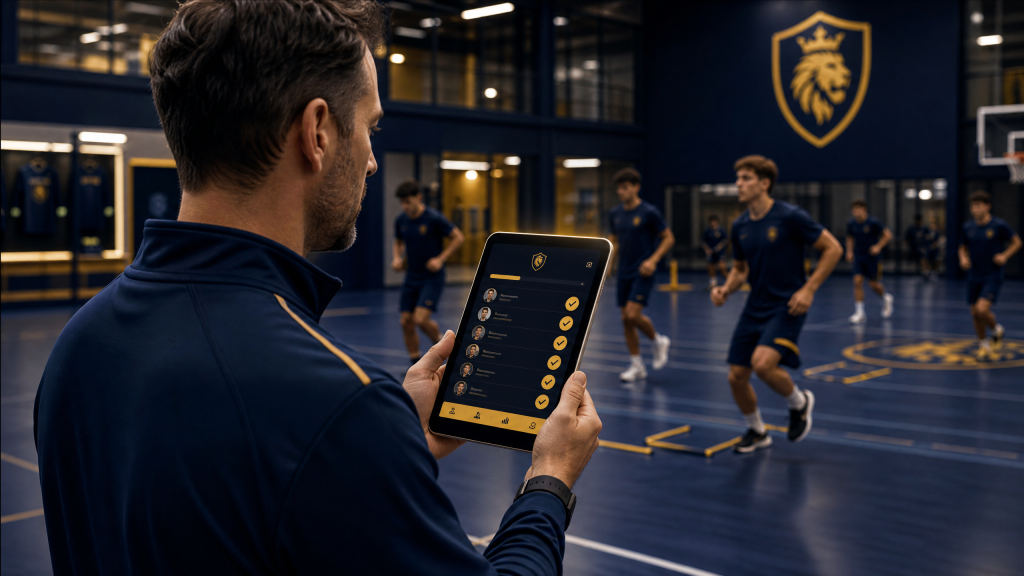
For larger clubs with multiple teams, multiple storage locations, and coaches who may not always be present at the facility, a digital check-out system is far more practical. Modern club management platforms allow coaches to log equipment usage directly from their smartphones, providing a real-time view of where every item is and who is responsible for it. This eliminates the “I thought someone else had it” problem that is responsible for so much equipment loss.
The key to making any check-out system work is consistency. It must be used every single time, by every single coach, without exception. This requires buy-in from the entire coaching team, which in turn requires clear communication about why the system matters. When coaches understand that the cost of lost equipment comes directly out of the club’s budget — money that could otherwise be spent on better training facilities or subsidised fees for families in need — they are far more likely to take the system seriously.
Equipment Maintenance: Prevention Is Always Cheaper Than Replacement
A proactive maintenance programme is one of the most cost-effective investments a sports club can make. Regularly inspecting and maintaining equipment extends its useful life significantly, reducing the frequency and cost of replacements.
For most youth sports clubs, a simple quarterly inspection is sufficient. During each inspection, every item in the inventory should be checked against the condition criteria established when the inventory was created. Items that have deteriorated should be flagged for repair or replacement, and the inventory record should be updated accordingly.
Different types of equipment require different maintenance approaches. Balls should be checked for proper inflation and surface integrity. Goals and nets should be inspected for structural damage and wear. Protective equipment such as shin guards and helmets should be checked for cracks or deformation that could compromise their protective function. Electronic equipment such as timing systems or video analysis tools should be tested to ensure they are functioning correctly.
Establishing a relationship with a local sports equipment supplier can also be valuable. Many suppliers offer maintenance services, repair kits, and bulk replacement pricing for clubs that purchase regularly. Building this relationship not only saves money but also ensures that you have a reliable source of quality equipment when replacements are needed urgently.
Budgeting for Equipment: Planning Ahead to Avoid Surprises
One of the most significant benefits of a well-maintained equipment inventory is the ability to plan and budget for equipment costs with confidence. Rather than being caught off-guard by unexpected replacement needs, club administrators can use their inventory data to forecast equipment expenditure for the coming season and beyond.
A practical approach to equipment budgeting involves categorising all inventory items by their expected remaining useful life. Items that are likely to need replacement within the next twelve months should be included in the current year’s budget. Items with a remaining life of one to three years should be included in a medium-term capital plan. Items in good condition with a remaining life of more than three years require no immediate budget allocation.
This approach transforms equipment management from a reactive, crisis-driven activity into a planned, strategic one. It also makes it much easier to justify equipment expenditure to club committees, parent associations, or funding bodies — because you can demonstrate exactly what you need, why you need it, and what it will cost.
When presenting equipment budgets to club stakeholders, it is worth emphasising the connection between well-maintained equipment and the quality of the training experience. Parents who understand that their membership fees are being used to provide safe, high-quality equipment are more likely to pay promptly and to support the club’s fundraising efforts. As we explore in our guide on sports club membership fee collection, transparency about how club funds are used is one of the most effective tools for improving fee payment rates.
Equipment Management for Multi-Sport Clubs
The complexity of sports club equipment management increases significantly when a club operates across multiple sports or multiple age groups. In these environments, equipment is often shared between teams, stored in multiple locations, and managed by coaches who may not communicate regularly with one another.
For multi-sport clubs, the most important principle is clear ownership. Every piece of equipment should have a designated owner — a specific coach or team administrator who is responsible for its condition and location. This does not mean that equipment cannot be shared; it simply means that there is always one person who is accountable for each item.
Colour-coding is a practical and low-cost way to manage shared equipment in a multi-sport environment. Assigning a specific colour to each team or sport — and marking all equipment with that colour using tape, paint, or labels — makes it immediately obvious when equipment has migrated to the wrong location. It also makes the check-out and check-in process faster and less prone to error.
The Role of Technology in Modern Equipment Management
Technology has transformed almost every aspect of sports club management, and equipment management is no exception. While a simple spreadsheet is a significant improvement over a mental note or a whiteboard list, modern club management platforms offer capabilities that go far beyond what any spreadsheet can provide.
The most valuable technological features for equipment management include digital inventory registers that can be updated in real time from any device, automated maintenance reminders that alert administrators when items are due for inspection, check-out and check-in logging that creates an audit trail for every piece of equipment, and integration with club budgeting tools that automatically updates financial forecasts when equipment conditions change.
These capabilities are no longer the exclusive domain of professional sports organisations. They are increasingly accessible to community clubs of all sizes, and the time savings they generate — compared to manual, paper-based systems — typically justify the investment within a single season. For clubs that are also managing the administrative burden of player registration, attendance tracking, and fee collection, an integrated platform that handles all of these functions in one place is transformative. Our guide on youth sports club attendance tracking explores how digital tools can similarly streamline that aspect of club management.
Communicating Equipment Policies to Coaches and Parents
Even the best equipment management system will fail if the people who use the equipment do not understand or respect the policies that govern it. Clear, consistent communication is essential to making your system work in practice.
For coaches, this means providing a clear written policy that explains the check-out and check-in process, the expectations around equipment care, and the consequences of failing to return or report damaged equipment. This policy should be reviewed at the start of every season and signed by every coach as part of their onboarding process.
For parents and players, the communication should focus on the shared responsibility for club equipment. Young athletes should understand that the equipment they use belongs to the entire club community — not just to them or their team. Teaching children to respect and care for shared equipment is not just good club management; it is a valuable life lesson about responsibility and community stewardship.
When equipment is damaged or lost, the response should be proportionate and educational rather than punitive. In most cases, damage is accidental, and the goal should be to understand what happened and prevent it from happening again — not to assign blame or demand payment. However, for cases of deliberate damage or negligence, having a clear policy in place ensures that the club can respond consistently and fairly.
Building a Culture of Equipment Care
Ultimately, the most effective sports club equipment management system is one that is supported by a culture of care and responsibility. When coaches model good equipment habits — packing up carefully after every session, reporting damage promptly, and treating club property with respect — young athletes follow their example.
This culture does not develop overnight, but it can be cultivated deliberately. Recognising coaches and teams who consistently demonstrate excellent equipment care sends a powerful message about the club’s values. Including equipment care as a topic in coach education and player development programmes ensures that it is treated as a genuine priority, not an afterthought.
The clubs that manage their equipment most effectively are not necessarily the ones with the most sophisticated systems or the largest budgets. They are the ones where every member of the community — from the head coach to the youngest player — understands that taking care of the club’s resources is part of what it means to be a member of that community. When that culture is in place, the administrative systems become almost self-maintaining, because everyone is invested in making them work.
Investing in proper sports club equipment management is an investment in the quality of your training environment, the safety of your athletes, and the financial sustainability of your club. It is one of the most practical steps any club owner or coach can take to professionalise their operations and create a better experience for everyone involved.